


The Men Behind the Siege of Fort Mifflin 1777
When British troops marched into Philadelphia on September 26, 1777, capturing the American capital did not solve their greatest problem: supply.

British transports loaded with food, ammunition, clothing and other necessities were waiting down the Delaware River, but American defenses stood between those ships and Philadelphia. At the center of that defensive system was a small fortification on Mud Island, several miles below the city, supported by Fort Mercer at Red Bank, New Jersey, the Pennsylvania Navy, armed galleys, river obstructions known as chevaux-de-frise, and shore batteries.
The resulting Siege of Fort Mifflin is generally dated from September 26 to November 16, 1777, although the devastating final bombardment occurred chiefly between November 10 and 15. For weeks, a surprisingly small and constantly changing American garrison prevented the British from freely using the Delaware River.[1]
You can watch a YouTube short about it here, but read on for details about the names of the known soldiers who were there, and other facts not mentioned in the short video.
The men who defended the fort came from Pennsylvania, Maryland, Virginia, Rhode Island, Connecticut, Delaware and Continental artillery units, with detachments entering and leaving the fort throughout the siege. Identifying an ancestor who actually served there requires more than finding his regiment mentioned in a history book.
Fortunately, surviving muster rolls, military correspondence, diaries, pension applications and even clothing returns allow us to identify a growing number of the men who were actually there.
A desperate situation on Mud Island
Lieutenant Colonel Samuel Smith of Maryland arrived at Fort Mifflin on the night of September 26–27. His report to George Washington the following day paints an alarming picture.
Smith reported shortages of ammunition and provisions and said that only about 60 untrained militiamen were serving as artillerymen. He also complained that the militia had refused to obey artillery officer Captain-Lieutenant Samuel Treat.
The defense was therefore not a polished operation conducted by a single veteran regiment. It was a constantly changing collection of Continental soldiers, state troops, militia and artillerymen trying to keep an unfinished fort functioning while the British steadily tightened their grip around it.[2]
Fort Mifflin's own history estimates that the garrison numbered roughly 200 men early in the struggle and eventually increased to around 400. French-born Continental engineer François-Louis Teissèdre de Fleury, writing from the fort on November 14, referred to a new garrison of about 450 men.[3]
A rare surviving Fort Mifflin muster roll
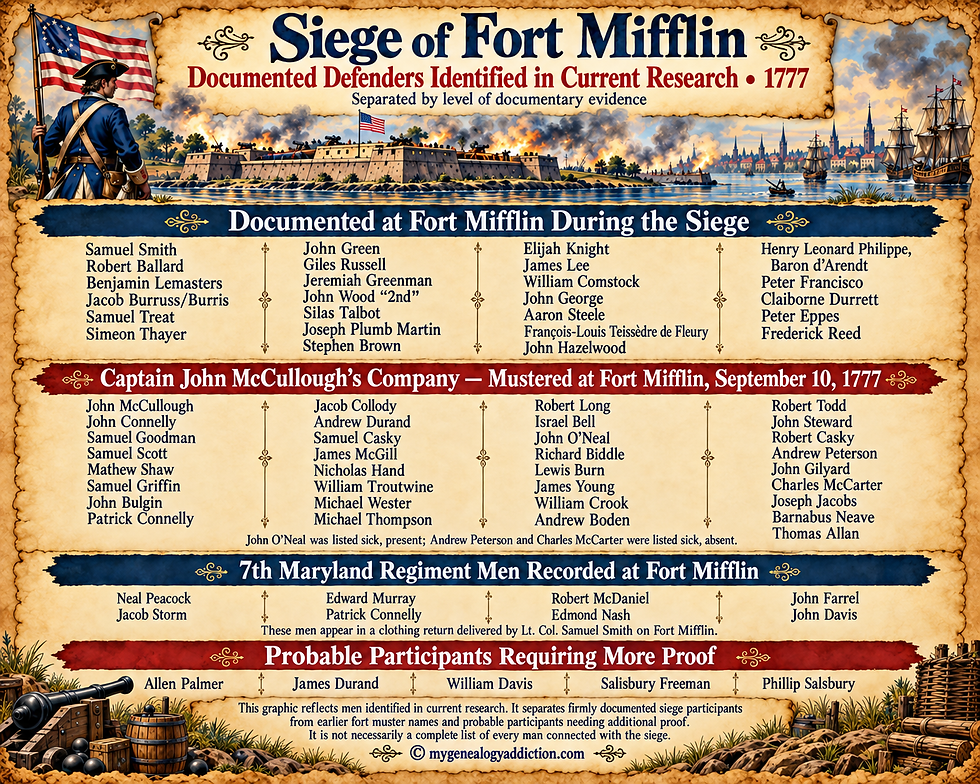
One of the most valuable records for genealogists is an actual muster roll for Captain John McCullough's Second Company of Artillery of the Philadelphia Militia, commanded by Colonel Jehu Eyre.[4]
Unlike a general regimental roster, this document specifically states:
“Fort Mifflin, September 10, 1777. Mustered then Captain John McCullough's company.”
The roll names 33 officers and men:
Rank or duty | Men recorded on the Fort Mifflin muster |
Captain | John McCullough |
Captain-Lieutenant | John Connelly |
Lieutenants | Samuel Goodman, Samuel Scott, Mathew Shaw |
Sergeants | Samuel Griffin, John Bulgin, Patrick Connelly, Jacob Collody |
Corporals | Andrew Durand, Samuel Casky, James McGill, Nicholas Hand |
Drummer & Fifer | William Troutwine, Michael Wester |
Bombardiers | Michael Thompson, Robert Long, Israel Bell, John O'Neal |
Gunners | Richard Biddle, Lewis Burn, James Young, William Crook |
Matrosses and support | Andrew Boden, Robert Todd, John Steward, Robert Casky, Andrew Peterson, John Gilyard, Charles McCarter, Joseph Jacobs, Barnabus Neave, Thomas Allan |
The details in the roll are important. John O'Neal was marked sick but present, while Andrew Peterson and Charles McCarter were sick and absent. Barnabus Neave was noted as a conductor and Thomas Allan as a clerk.[5]
There is also an important warning for family historians: this muster was taken on September 10, before the siege intensified. It proves that the company was stationed at Fort Mifflin on that date; by itself, it does not prove that every man remained through the October and November fighting. That distinction is exactly why Fort Mifflin research requires examining individuals rather than simply copying entire regimental rosters.
Maryland soldiers at the fort
Samuel Smith himself was a Maryland officer, but he was not the only Marylander at Fort Mifflin.
A fascinating surviving record is titled essentially an account of clothing delivered by Lieutenant Colonel Smith “on Fort Mifflin” to soldiers under his command from the 7th Maryland Regiment.
Eight men appear on the surviving list: Neal Peacock, Jacob Storm and Edward Murray, associated with Williams' company, and Patrick Connelly, Robert McDaniel, Edmond Nash, John Farrel and John Davis, associated with Bayley's company.[6]
One of these men, Neal Peacock, is independently reported as having been wounded during the siege of Mud Island Fort, strengthening the connection between this Maryland detachment and the actual fighting.[7]
This clothing return is a wonderful example of why genealogists should search beyond traditional muster rolls. A seemingly mundane record about shirts, shoes, stockings and blankets can establish that a particular soldier was serving at a particular fort.
Virginia soldiers and the power of pension applications
Revolutionary War pension files provide some of the most vivid evidence of individual Fort Mifflin service.
Benjamin Lemasters, a soldier of the 1st Virginia Regiment, later testified that he spent about a month at the siege under Smith. He remembered seeing the British warship HMS Augusta destroyed on the Delaware and said that during the siege he rode as an express messenger from Smith to George Washington at Whitemarsh.[8]
Another remarkable account comes from Sergeant Jacob Burruss, or Burris, of the Virginia Line. His pension testimony stated that he was detached with other soldiers to Mud Island Fort, crossed the Delaware above Philadelphia, traveled down the New Jersey side and entered Fort Mifflin by boat at night.
Burruss recalled serving there throughout the siege under Smith and being attached to Samuel Treat's artillery. He reported being wounded twice by flying splinters produced when British cannonballs struck the fort's timbers.[9]
Another Virginia veteran, Claiborne Durrett, later specifically named Mud Island alongside Brandywine and Germantown when describing his Revolutionary service in his pension declaration.[10]
These records demonstrate why an ancestor's pension file can be far more revealing than a simple compiled service record.
The Rhode Islanders arrive
Rhode Island troops played a particularly complicated role because detachments moved between Fort Mercer and Fort Mifflin.
Surviving garrison orders show that on October 19, Major Simeon Thayer was ordered to take a detachment from Colonel Israel Angell's 2nd Rhode Island Regiment consisting of 3 captains, 9 subalterns, 12 sergeants, 4 drummers and fifers, and 121 rank-and-file soldiers to Fort Mifflin.
That was nearly 150 men. They were sent to relieve a detachment from Colonel Christopher Greene's 1st Rhode Island Regiment.[11]
One of Thayer's men was Sergeant Jeremiah Greenman, whose diary gives us a soldier's-eye view of the experience. On October 21 he recorded that he was continuing at Fort Mifflin and described the duty simply as “very hard indeed.”
The following morning, October 22, Thayer's detachment crossed back to Fort Mercer—just in time to participate in the Battle of Red Bank against attacking Hessian troops.[11]
Thayer would later return to Fort Mifflin and eventually take command during its final terrible days.
Connecticut soldiers and Joseph Plumb Martin
As casualties and exhaustion reduced the garrison, fresh troops were sent in.

The U.S. Army's history of the Philadelphia Campaign records that during the nights of November 11–13, Lieutenant Colonel Giles Russell and troops of the 4th and 8th Connecticut Regiments entered Fort Mifflin to relieve Smith and the surviving Virginia Continentals.[12]
Among the Connecticut soldiers was a young private whose memoir would become one of the best-known enlisted men's accounts of the American Revolution: Joseph Plumb Martin.
Martin later described the miserable conditions inside the shattered fort—the mud, exhaustion and almost constant danger from British shot and shell. The American Battlefield Trust likewise identifies Martin as one of the soldiers who garrisoned Fort Mifflin during the siege.[13]
His presence is particularly valuable to historians because his later memoir allows us to experience the siege through the eyes of an ordinary Continental soldier rather than only through officers' reports.
Artillerymen from several commands
The artillery inside Fort Mifflin deserves special attention.
Samuel Smith's September 27 letter identifies Samuel Treat as the artillery officer at the fort. Treat belonged to the Continental artillery and was later killed during the fighting.[14]
Other Continental artillery units operated throughout the Delaware defenses. The recent U.S. Army campaign history identifies Captain David Cook's company of the 3rd Continental Artillery among the artillery forces in the Delaware forts and Captain James Lee of the 2nd Continental Artillery operating heavy guns against British shipping during the campaign.[15]
The result was an exceptionally mixed garrison: Pennsylvania militia artillerymen could be serving beside Continental artillerymen, Virginia infantrymen and temporary detachments from Rhode Island or Connecticut.
The Pennsylvania Navy fought beside them
The defense of Fort Mifflin cannot be understood solely as an army action.
Commodore John Hazelwood and the Pennsylvania Navy fought on the Delaware with armed galleys and other vessels, supporting the forts and helping protect the river obstructions. The defenders even enjoyed a dramatic success on October 23 when the British ships HMS Augusta and HMS Merlin became stranded during operations near the forts; Augusta caught fire and exploded, while Merlin was subsequently destroyed to prevent her capture.[15]
An ancestor involved in the Fort Mifflin campaign, therefore, might appear in naval records rather than an army regiment.
The final bombardment

Beginning on November 10, the British brought overwhelming firepower against the fort from batteries on Province and Carpenter's Islands.
Smith and Fleury were wounded. Reinforcements replaced exhausted defenders, and command eventually passed to Major Simeon Thayer. By November 15, British warships had maneuvered into positions from which they could fire directly into Fort Mifflin at extremely close range.
The fort's guns were progressively disabled, its powder was nearly exhausted, and its defenses had been shattered.
Rather than sacrifice the survivors, Thayer ordered the fort evacuated. During the early morning hours of November 16, 1777, the remaining Americans crossed to New Jersey. They left the flag flying over the ruined fort.
British troops entered several hours later.[15]
The fort had fallen—but only after delaying British use of the Delaware for weeks.
A lesson hidden in the battle
For family historians, Fort Mifflin provides a perfect illustration of how Revolutionary War service should be researched.
An ancestor's regiment may have participated in the Philadelphia Campaign without the ancestor himself ever entering Fort Mifflin. Conversely, a man whose regiment is not normally associated with the fort may have been temporarily detached there for only a few days.
Search terms matter too. In pension applications and contemporary documents the fort may appear as Fort Mifflin, Mud Island, Mud Island Fort, Mud Fort, Mudfort, or simply the fort on Mud Island. Searching only for “Fort Mifflin” can therefore miss valuable records.[16]
The surviving evidence already gives us dozens of identifiable defenders—from Philadelphia artilleryman John McCullough, Maryland soldier Neal Peacock, Virginians Benjamin Lemasters and Jacob Burruss, Rhode Island sergeant Jeremiah Greenman, Connecticut private Joseph Plumb Martin, and many ordinary gunners, bombardiers, matrosses and infantrymen whose names rarely appear in traditional battle histories.
And the roster is still incomplete. Somewhere among surviving orderly books, company returns, pension files, casualty reports, clothing accounts and military correspondence are undoubtedly the names of still more of the men who endured the guns at Mud Island in the autumn of 1777.
For genealogists with an ancestor who served in the Philadelphia Campaign, those records may provide the evidence that finally answers an exciting question: Was my ancestor one of the defenders of Fort Mifflin?
Behind the Research:
ChatGPT by OpenAI assisted with researching, organizing, and drafting this article. The final article was reviewed and edited for publication by MyGenealogyAddiction.com, with links to the historical sources used throughout the research.
Sources
[1] National Park Service, “The Philadelphia Campaign of 1777.” Includes the November 10–15 bombardment and evacuation of Fort Mifflin. https://www.nps.gov/articles/000/philadelphia-campaign-1777.htm
[2] Lieutenant Colonel Samuel Smith to George Washington, September 27, 1777, Naval Documents of the American Revolution. Smith's report from Fort Mifflin describing the militia artillerymen, shortages and condition of the garrison. https://www.navydocs.org/node/24632
[3] Fort Mifflin on the Delaware, “The History.” Overview of the 1777 defense, changing garrison strength and strategic importance of the fort. https://www.fortmifflin.us/the-history
[4] Pennsylvania Archives, Pennsylvania in the War of the Revolution, Associated Battalions and Militia, 1775–1783. Captain John McCullough's Second Company of Philadelphia Artillery muster, Fort Mifflin, September 10, 1777. https://wolfensberger.org/pages/library/books/Pennsylvania/pennsylvaniaarch04penn.pdf
[5] Pennsylvania Archives, Pennsylvania in the War of the Revolution, Associated Battalions and Militia, 1775–1783. Captain John McCullough's Second Company of Philadelphia Artillery muster, Fort Mifflin, September 10, 1777. https://wolfensberger.org/pages/library/books/Pennsylvania/pennsylvaniaarch04penn.pdf
[6] 7th Maryland Regiment clothing account, transcription of a record identifying soldiers receiving clothing under Lt. Col. Samuel Smith at Fort Mifflin, including Neal Peacock, Jacob Storm, Edward Murray, Patrick Connelly, Robert McDaniel, Edmond Nash, John Farrel and John Davis. https://sites.google.com/site/sjzscertainfolksandevents/nathan-nash
[7] Revolutionary War Patriots Buried in Ohio https://www.ohiohistory.org/wp-content/uploads/2025/06/Revolutionary-War-Patriots-Buried-in-Ohio_opt.pdf
[8] Benjamin Lemasters, Revolutionary War Pension Application S18490. Lemasters recalled a month at Fort Mifflin, the destruction of Augusta, and carrying messages between Smith and Washington. https://revwarapps.org/s18490.pdf
[9] Jacob Burruss/Burris, Pension Application W340. His testimony describes his journey to Mud Island, service under Smith and Treat, and two wounds suffered during the siege https://www.gloucestercountynj.gov/DocumentCenter/View/16176/African-Americans-at-Red-Bank-Bob-Seligpdf
[10] Pension Record of Claiborne Durrett https://www.werelate.org/wiki/Person%3AClaiborne_Durrett_%281%29
[11] Christian McBurney, “A Rhode Island Officer's Recollections Lead to New Information on Battle of Red Bank,” Journal of the American Revolution. Uses Rhode Island orderly books and diaries to reconstruct Simeon Thayer's approximately 149-man Fort Mifflin detachment. https://battleofrhodeisland.org/new-information-on-battle-of-red-bank
[12] Joseph A. Seymour, The Philadelphia Campaign, 1777, U.S. Army Center of Military History. Modern U.S. Army campaign history covering the Delaware forts, Rhode Island troops, Continental artillery, Connecticut reinforcements and final evacuation. https://www.govinfo.gov/content/pkg/GOVPUB-D114-PURL-gpo240180/pdf/GOVPUB-D114-PURL-gpo240180.pdf
[13] Joseph Plumb Martin, American Battlefield Trust. Biography documenting Martin's service in the Fort Mifflin garrison. https://www.battlefields.org/learn/biographies/joseph-plumb-martin
[14] François-Louis Teissèdre de Fleury, Journal, November 14, 1777, Naval Documents of the American Revolution. Firsthand account from inside Fort Mifflin during the final bombardment. https://www.navydocs.org/node/25422
[15] The Philelphia Campaign 1777 https://www.govinfo.gov/content/pkg/GOVPUB-D114-PURL-gpo240180/pdf/GOVPUB-D114-PURL-gpo240180.pdf
[16] Frederick Reed, Pension Application S43911. A Delaware Regiment veteran who specifically recalled participating in the actions at “Mudfort” and Red Bank. https://revwarapps.com/s43911.pdf


Comments