


Stone Arabia, New York and the Hallenbeck and Hollenbeck families
Recently I've been working on the Hollenbeck branch of my family tree, prompted by a cousin's inquiry. Presently, the earliest ancestor we have identified is John Hollenbeck, born about 1776 in Stone Arabia, Montgomery County, New York.
With little to go on, I decided to take a look back at Stone Arabia, New York during the American Revolution, to see if we can find the Hollenbeck/Hallenbeck family woven into the local history and understand who they were and what life looked like around them in the 1770s.
Stone Arabia: The Place and Its People
Long before the Revolution, the lands along the Mohawk River where the present-day hamlet of Stone Arabia sits were part of the frontier of colonial New York. In the early 1700s the British Crown granted the Stone Arabia Patent (about 12,700 acres) to a group of German Palatine settlers in 1723, many of whom had first come to New York in 1712 as refugees from war and famine in the Rhineland. These families cleared forests, built homes, planted wheat and other crops, and established deeply rooted communities of Dutch Reformed and Lutheran faiths that blended German and Dutch cultures into a distinctive Mohawk Valley identity.

Stone Arabia grew into a thriving agricultural district by the 1770s, dotted with farms, churches, mills, taverns, and small shops. Crops like wheat, potatoes, corn and flax fed local families and served markets much further afield. The valley’s wheat was prized throughout New York. Many settlers spoke a hybrid of German, Dutch, English and Indigenous languages sometimes affectionately called “Mohawk Dutch.”
Locals also formed militia companies as the Revolution approached. Committees of Safety and militia rosters show that many families - patriotic as well as loyalist - took sides or found themselves pulled into the conflict early.
The Hallenbecks/Hollenbecks are an old Dutch-American family tracing back to early colonial times, with roots in Albany County from the mid-17th century onward and branches spreading outward across New York over the next century. The family name appears in variant spellings: Hallenbeck, Hollenbeck, Halenbeck, Hollenbeek, Holenbek, etc. This was common in colonial record keeping.
The Hollenbecks weren't Palatine Dutch. They were Netherland Dutch, although they married into Palatine German families, as was common. Palatine Germans used names such as Johannes, Catharina, Heinrich and Annetje.
By the Revolutionary era, branches of the family had become part of the fabric of frontier settlements like those around the Mohawk Valley, including Stone Arabia and nearby areas.
Though detailed parish or census records connecting every Hallenbeck to Stone Arabia in the 1770s are sparse in online sources, family-history compilations and Revolutionary War service records strongly suggest that members of the Hallenbeck/Hollenbeck clan were present in the wider region and took active roles in local militia units defending their homes and the Patriot cause.
The Hallenbecks, like many colonial families, likely owned farms worked by extended family networks and participated in community life centered on churches and markets.
Life in Stone Arabia in the 1770s
In the decade before 1780, everyday life in Stone Arabia was a blend of farming rhythms and rising tensions of war. Men of fighting age drilled with militia regiments. Farms produced wheat and animal stock that sustained not just households but continental forces. Churches and taverns, such as Adam Loucks’ tavern where locals drew up a set of pre-Revolutionary resolves in 1774, were civic centers as well as spiritual and social ones.
Yet there was also deep complexity beneath these patterns of peaceful life. Not all neighbors saw the conflict the same way: families could be divided between loyalty to the British Crown and commitment to American independence. That division magnified the chaos when Loyalist leaders and Indigenous allies began launching raids deep into the Mohawk Valley from Canada and the Schoharie Valley - campaigns intended to disrupt food production and break the will of the Revolution.
The 1780 Attack: Burning and Battle in Stone Arabia
October 19, 1780, was a turning point for Stone Arabia. A Loyalist-led force under Lieutenant Colonel Sir John Johnson, composed of British regulars, Loyalist refugees and Native allies including forces under Captain Joseph Brant, marched up the valley with orders to destroy farms and supplies critical to the Patriot cause.

Local militiamen, including New York militia and Massachusetts levies under Colonel John Brown, rallied from Fort Paris (one of several fortified homesteads in the area) to intercept them. They met in a brief but fierce engagement roughly a mile from the settlement. Outnumbered and outmaneuvered, the militia was defeated. Colonel Brown was killed in the fighting.
Johnson’s troops then followed through on their objective. They destroyed dozens of homes, barns and other buildings throughout Stone Arabia. They even burned the Dutch Reformed and Lutheran churches that stood at the heart of community life. The settlement was left in smoking ruins. Many families fled to forts for shelter and fought to save what they could of their lives and property.
For families like the Hallenbecks, this raid would have been a moment of catastrophe with the loss of crops, barns, houses and possibly possessions sorely needed for survival through winter. But the residents did not abandon the region. Contemporary accounts record that even after almost complete destruction, they rebuilt farms and continued their pursuit of the American dream.
In the years after the Revolution, Stone Arabia’s churches rose from the ashes, rebuilt in stone and wood as symbols of community resilience. The memory of 1780, the burning of homes and the sacrifice of militiamen and settlers, became part of local lore, preserved in cemetery markers and annual commemorations.
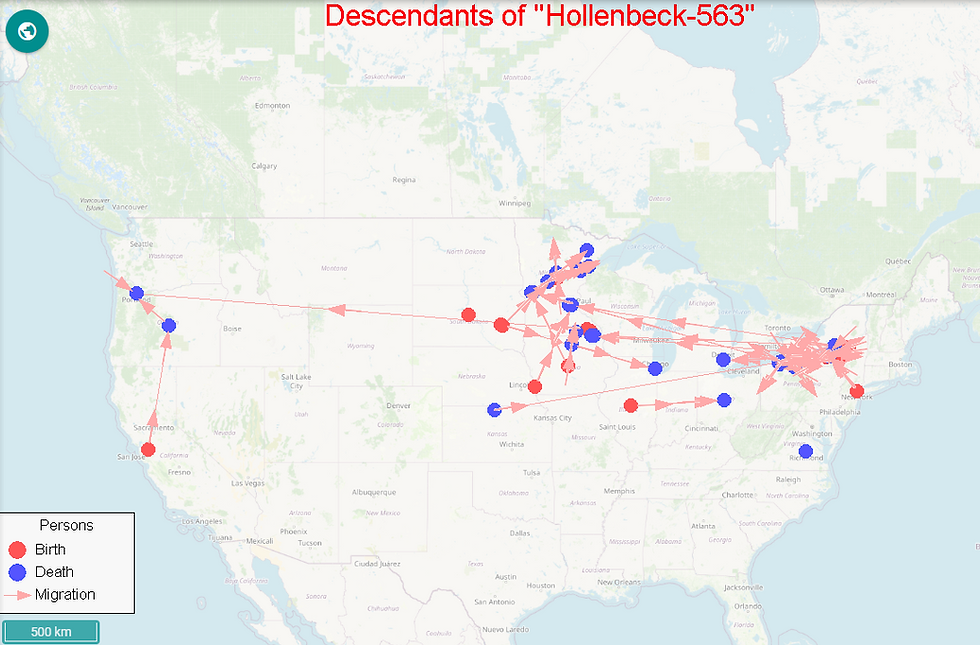
Descendants of the original settlers, including families like the Hallenbecks, spread throughout upstate New York and beyond, carrying with them stories of frontier hardship, war service, and agricultural perseverance.
The following interesting history is from "Forts and Firesides of the Mohawk Country, New York : Stories and Pictures of Landmarks of the Pre-Revolutionary War Period Throughout the Mohawk Valley and Surrounding Countryside, Including Some Historical and Genealogical Mention During the Post-War Period", by John J. Vrooman, 1951:
Though the settlement at Stone Arabia had its beginning about 1712, it wasn't until 1723 that a Patent was issued. It is interesting to note the names which appear on this document, many of them still frequently encountered in the Valley, while others, due to removal of the original settler, perhaps to Pennsylvania, where large numbers of Palatines were settling, have disappeared locally. The names of the grantees as given are: Casselman, Coppernoll, Dillenbeck*, Dygert, (Diegart), Emiger, Fox (Vocks), Fink (Feink), Erhart (Erchart), Ingland (Ingold), Garlock (Garlack), Lawyer, Nellis (Nelse), Piper (Pieper), Seeber (Siebert), Shawl (Scheel), Shaeffer.
This Patent, known as the Stone Arabia Patent, and the one at German Flatts, known as the Burnetsfield Patent, were of great importance in that they were the first issued which make a direct distribution of land to individual settlers, in such amount as represented a reasonable and immediately usable acreage in contrast with the enormous acreage contained in some of the patents given to court favorites and politicians. The entire extent of the Stone Arabia Patent as issued to this group of twenty-seven settlers was but 12,700 acres, whereas the estate of Sir William Johnson at his death consisted of some 700,000 acres!

This settlement was made in the virgin forest and the first and enormous task of the settlers was to clear enough land to put in subsistence crops. Yet busy as they were, raising enough to live on, they found time in 1729 to build a log church. This was on the site of the present frame building which is the Lutheran Church, and was part of the land of William Coppernoll of Schenectady, the only Hollander among this group of Palatines. The contract for the land was dated June 2nd, 1729, and conveyed fifty acres.
In 1733 a new frame structure was begun but a controversy arose as to the name to be given it. This proved an insurmountable stumbling block, for the Lutherans withdrew and continued in the log edifice while the Reformed group went on with the new building. This would seem to indicate that William Coppernoll, who would have been of the Reformed group, must have been joined by other Hollanders in the ten years following the settlement. The tract of fifty acres originally conveyed for the church was equally divided between the two groups.
The Reformed Church is the result of a European revival known as the "Reformation" and as the name implies affected the churches of Holland. The term "Reformed" indicates a belief in the symbolic presence of the Christ in the Communion in distinction to the belief of a physical presence as held by Luther and his followers. The term "Protestant," so long used, indicated a protest against the assumed authority of the Church of Rome and its interpretation of the Scriptures. The title "Reformed (Dutch) Church" was adopted in 1867. The seal of the Church is based on the seal of Prince William of Orange. In 1826 the pillars were added to the seal with superimposed stars to suggest an ecclesiastical and heavenly life. The motto above is in Latin, which translated means, "Without the Lord all is vain." The motto below, in Dutch means, "Union makes strength."
The oldest record book of the Lutheran Church at Stone Arabia states the fact that the original Church here was organized by Domine Ehle in 1711, which of course is in error as the Domine did not come to America until 1722. But it is an error of a few years only, for it is known he did found the Church soon after his coming into the Valley, probably about the year 1725. At the time the settlement was made at Stone Arabia the road along the north shore of the river was opened only as far as Fonda, and it was not until 1726 that a move was made to extend it westward to the present Utica. A realization of this fact helps one to grasp the picture and to realize the difficulties encountered in making the settlement. The river was still the chief artery of commerce.
The Reverend Johannes Schuyler is named as the minister in the earliest records of the Dutch Church, which are dated October 24th, 1743. The Reverend Schuyler is buried beneath the pulpit in the "Old Stone Fort" at Schoharie, which then was the Dutch Church. He was its pastor at the time of his death in 1779. His wife was Annatje Veeder of Schenectady, whom he married in 1743. Their sixth child, Philip, was the builder of the present stone building at Stone Arabia which he finished in 1788. He is said to have been five years in completing the work at a cost of $3,378, and at that time it was perhaps the finest church edifice west of Schenectady, the only possible exception being the Fort Herkimer Church. It was the Reverend Schuyler's sister Elizabeth who married Gose Van Alstyne of Canajoharie, whose house is still standing and has been previously described.
Prior to the building of the stone edifice, both the Lutherans and Reformed groups had frame buildings at Stone Arabia and the "Battle of Stone Arabia" was an effort on the part of the settlers to protect their homes and these churches from destruction in a Tory raid of 1780. The local "post" was known as Fort Paris (after Isaac Paris, one of the early settlers) and was in charge of Colonel Brown of the militia. Word had been sent by General Van Rensselaer of the Colonial Army in pursuit of the raiders, who were under Sir John Johnson, that Colonel Brown should attack the enemy as soon as they appeared and that he, General Van Rensselaer, would attack from the rear. This was a logical and well laid plan as Sir John lay encamped the night before the battle between the two Colonial forces.
Colonel Brown, faithful to his orders, left his fort and was only about a mile from it toward the enemy's location when he engaged them. General Van Rensselaer failed to follow the enemy and attack from the rear as agreed, with the result that Colonel Brown's force, much smaller than that of Sir John, was cut to pieces and the Colonel killed. The Indians, who were a part of the raiding force, scalped and stripped their victims and all retreated up the Valley en route toward Canada, after burning most of the houses and both churches. They were engaged the next afternoon by General Van Rensselaer at the "Battle of Klock's Field."
The bodies of the slain at Stone Arabia were buried in a trench close by Fort Paris. The battlefield is identified by a large inscribed boulder. The body of Colonel Brown was removed later and placed in the churchyard of the present Dutch Church, and a fitting monument erected. In the church cemetery are the graves of many Revolutionary soldiers. The location of Fort Paris was a half mile southeast of the church, near the crossroads. Nothing remains of it today.
There is a striking similarity between the churches of this period, such as this one, the one at Palatine, the Fort Herkimer Church, and the "Old Stone Fort" at Schoharie. These four buildings are outstanding, historically and architecturally, among the very few of this age remaining within the entire United States. Their appealing simplicity, the enduring strength of their massive stone walls and the quiet charm of their steeples is indicative of the life and character of their congregation for "By their works ye shall know them."
Continue reading at Archive.org for more.
I searched through the Records of the Reformed Dutch Church of Stone Arabia: in the town of Palatine, Montgomery County, N.Y. database on Ancestry.com but found no Hollenbeck, Hollenbach, Hallenbeck, Hollenbeek, or Hallonbach records. I also searched the Montgomery County Religious Records with no luck.
*The Dillenbeck or Dillenbach name is said to have been a variation of the Hollenbeck name. There were some Dillenbach records. Names included Deterich Dillenbach, Andrew A. Dillenbach, Martinus Dillenbach, Henry Dillenbach, Andreas Dillenbach, Christina Dillenbach, Lena Dillenbach, Henry J. Dillenbach, Heinr. Dillenbach, Jacob Dillenbach, Johannes Dillenbach, Balthasr Dillenbach, Christian Dillenbach, Benjamin Dillenbach, and Daniel Dillenbach. (There were dozens of Dillenbeck households in Stone Arabia in 1868. See map here at historicmapworks.com.)
Another great source for finding early records from Stone Arabia is in the Records of the Lutheran Trinity Church of Stone Arabia, available on FamilySearch (Film #008624986). This valuable book contains the following:

The list of early lots granted to the Paletines was:


The book provided these two photos of the first two churches in Stone Arabia:

(Feel free to download and share the church images on the condition that you do not remove the text.)
The Palatine Stone Church, erected in 1770, still stands today. It escaped destruction during the 1780 raid, which destroyed The Trinity Church, now the Trinity Lutheran Church, down the road. It was rebuilt in 1792. The sign above the entrance reads: "Original location of first log church of the Palatines built 1729, burned by the Tories and Indians Oct. 19, 1780. Present Church erected 1792":
If the map doesn't appear, click here to see it on GoogleMaps. Continue down the road to see the Palatine Stone Church. Much information about the churches is found here on p. xxi, from the same source.

Seeing this record explains why in John Hollenbeck's family Bible, his birthplace appeared to be spelled "Stoneraub". Clearly they didn't know how to spell the name "Stone Arabia". Note also that if he was born in August 1776, it was only eight years after the above petition was dated.

Other findings:
The confirmation of Baltasar Halenbeck and Maria Halenbeck. [Link] Baltsar Halenbeck also found here.
Hollenbeck Wills in Cortland County 1808-1937 (FamilySearch)
Name | # | Death Date | Date of Probate | Will Book & Page | Letters of Testamentary Book & Page |
John C. Holenbeck of Preble | 9625 | blank | 1828 Sept 17 | No. 4 p. 71 | blank |
"Deceased Sept. 20th 1828"? Wife: Ruth, Two sons: Abraham (the eldest) and John, Only daughter: Mary Beaman; Grandson: John Henry Hollenbeck. Will written Feb. 19, 1826. | |||||
Abraham Hollenbeck of Preble [Wikitree] | 8676 | 1864 Apr 10 | 1865 July 12 | ||
May 16, 1864 George Hollenbeck and Frank Hiscock granted Letters Testamentary. Wife: Mary; Sons: Mattias Hollenbeck, John H. Hollenbeck, George Hollenbeck; Daughter: Henrietta Trowbridge(?) wife of Philetus Trowbridge, and Sally VanBuskirk. Grandchildren: Abraham VanBuskirk and Mary VanBuskirk. Burial in Tully, Onondaga, New York. (Findagrave memorial shows a son named John Hollenbeck (1808-1856), but there may be some confusion because Abraham mentioned his son John in his will in 1864. | |||||
John Hollenbeck of Preble [Wikitree] | 1870 June 18 | 1871 May 15 | J p. 431-432 | C p. 424 | |
Sons: Casper, Garret and Abram Henry Hollenbeck. Dau: Mary (Mrs. Wm. Hoag). Burial in Preble. Born Feb. 3, 1791. Married Elizabeth Van Hoesen. | |||||
Mathias Hollenbeck | 7912 | blank | 1875 June 7 | D p. 115F | |
Keturah Hollenbeck named Executrix on May 3, 1875, after his death. Burial in Preble. Son of Abraham? | |||||
Frederick Hollenbeck of Virgil | 5148 | 1885 Oct 12 | 1885 Nov 28 | F p. 25 | |
Will dated Jan. 25, 1877; Wife: Mary Jane Hollenbeck; Executor: W.J. Hollenbeck; Children mentioned but not named. | |||||
Keturah (Van Hoesen) Hollenbeck of Preble (1815-1897) | 6565 | 1874 Feb 10 | 1899 May 7 | G. p. 126 | |
Widow of Matthias; To her sister, Catherine C. Hollenbeck(?) of Clinton, Rock County, Wisconsin, Brother: Robert Van Hoesen of Ellsworth, Noble County, Minnesota, Sister: Mrs. Angie Townsend of Clinton, Rock County, Wisconsin, Brother: Benjamin Van Hoesen of Preble, and others. Burial in Preble. | |||||
William J. Hollenbeck of Cortland | 4242 | 1901 Aug 31 | 1901 Sep 18 | G. p. 395 | |
Son: Ray W. Hollenbeck of Cortland, Fred D. Hollenbeck of Cortland, Glen P. Hollenbeck of Cortland, | |||||
Albert Hollenbeck | 5479 | 1913 Apr 3 | 1913 May 1 | 7 p. 7 | H p. 556 |
If you are a descendant of John Hollenbeck or other Hollenbecks/Hallenbecks in central New York, please consider adding your branches to Wikitree. His profile can be found here: Hollenbeck-563.


Comments